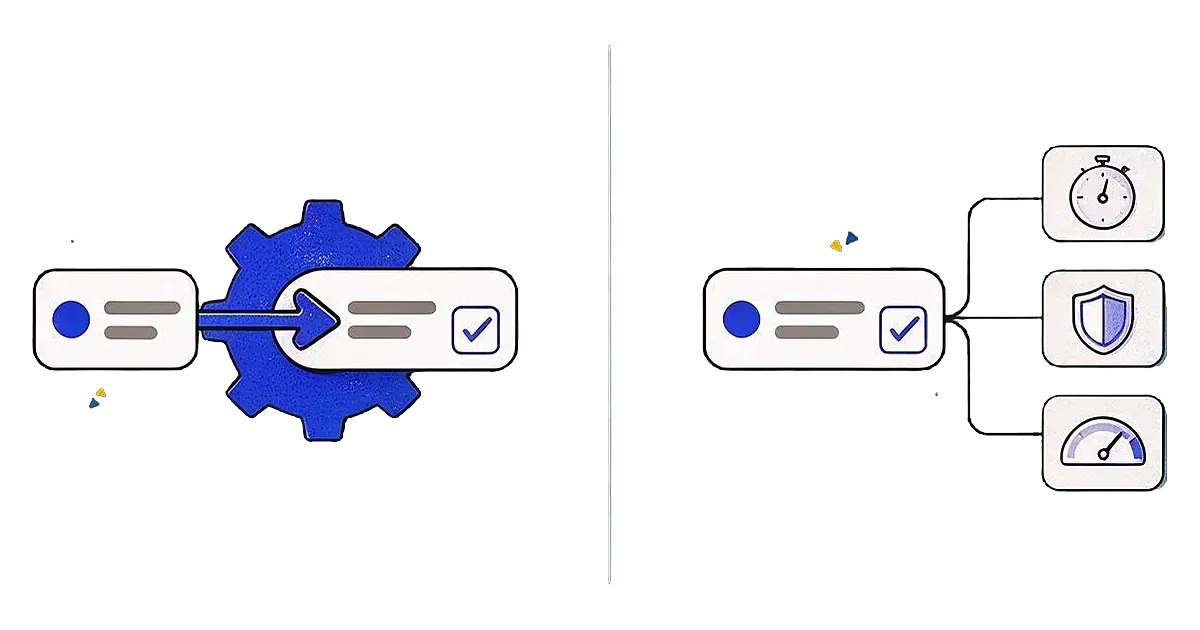
A functional requirement says what a system does: a behavior, a calculation, or a response to an input. A non-functional requirement says how well it does it, or under which constraint: speed, availability, security, accessibility. A quick test: if you can write it as an input and an expected output, it is functional.
This page focuses on functional requirements and on telling the two kinds apart. For a full catalogue of quality attributes with testable wording, see our non-functional requirements examples. When a behavior has several steps and failure paths, a use case template holds it better than a flat list.
What are functional requirements?
Functional requirements describe the behavior the solution must provide. Each one names a trigger or input, what the system does, and the result someone can observe. They answer the question "what must the system do?"
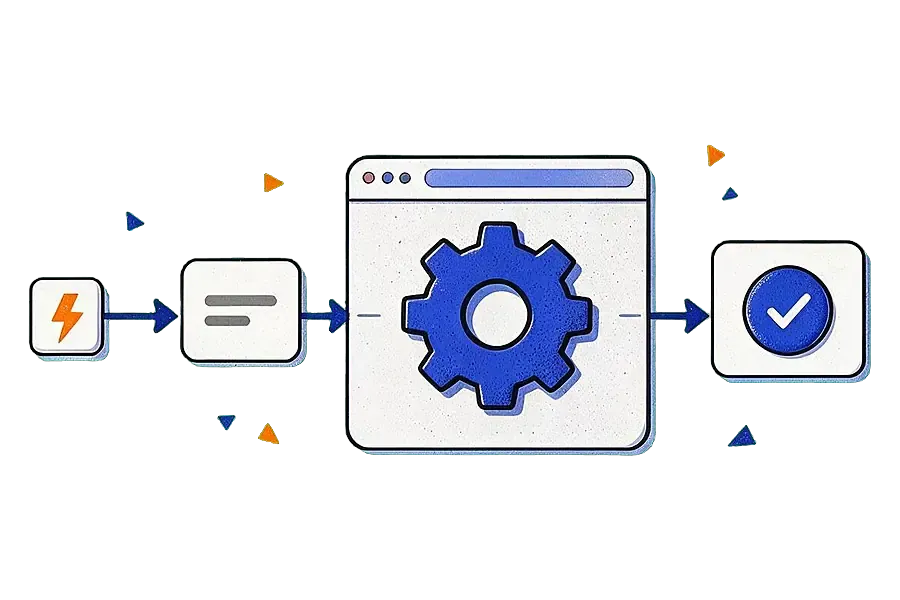
The IIBA’s BABOK Guide classifies requirements into business, stakeholder, solution and transition requirements. It then splits solution requirements into functional and non-functional. That split is what most teams mean by "functional vs non-functional requirements".
The international standard for requirements engineering, ISO/IEC/IEEE 29148, adds a useful discipline: each requirement should be necessary, unambiguous, verifiable and singular. A functional requirement that fails those checks is usually two requirements, or a wish.
What are examples of functional requirements?
The examples below are for a fictional wallet app, Qirsh Wallet. They are grouped by the area of the system they touch.
- Sign-in. The app locks the account for 15 minutes after five failed sign-in attempts.
- Sign-in. The holder can reset a password through a link sent to the registered email address.
- Transfers. The holder can send money to a saved contact by choosing the contact and entering an amount.
- Transfers. The app rejects a transfer that would exceed the holder’s daily limit and shows the remaining limit.
- Splitting. The holder can split a bill evenly among up to 10 saved contacts.
- Splitting. Each contact receives a request with the amount and the holder’s note.
- Notifications. The app notifies the holder when a contact pays or declines a request.
- Reporting. The holder can export the last 12 months of transactions as a CSV file.
- Support. A support agent can view the status of any transfer by its reference number.
- Administration. A compliance officer can change the daily limit, and the change is recorded in the audit log.
Each one names an actor or trigger, an action and a result you can check. None of them says how fast, how secure or how available. Those qualities are the non-functional half.
How do functional and non-functional requirements differ?
| Aspect | Functional requirements | Non-functional requirements |
|---|---|---|
| Question answered | What must the system do? | How well, or under which constraint, must it do it? |
| Typical form | The system shall [do something] when [trigger] | The system shall [behavior] within [measurable limit] |
| Example | The holder can split a bill among saved contacts. | 95% of split requests are confirmed within 2 seconds. |
| Scope | Usually one feature or step | Often the whole system or many features |
| How you test it | Run the input, compare the output | Measure under load, audit, or inspect against a threshold |
| What happens if it is missing | A feature does not exist | The feature exists but is slow, unsafe or unusable |
| Where it usually lives | Use cases, user stories, the requirements list | A quality section of the BRD, PRD or specification |
How do you tell which one you have?
Ask whether the statement describes a behavior or a quality of a behavior. These pairs show the same topic written both ways.
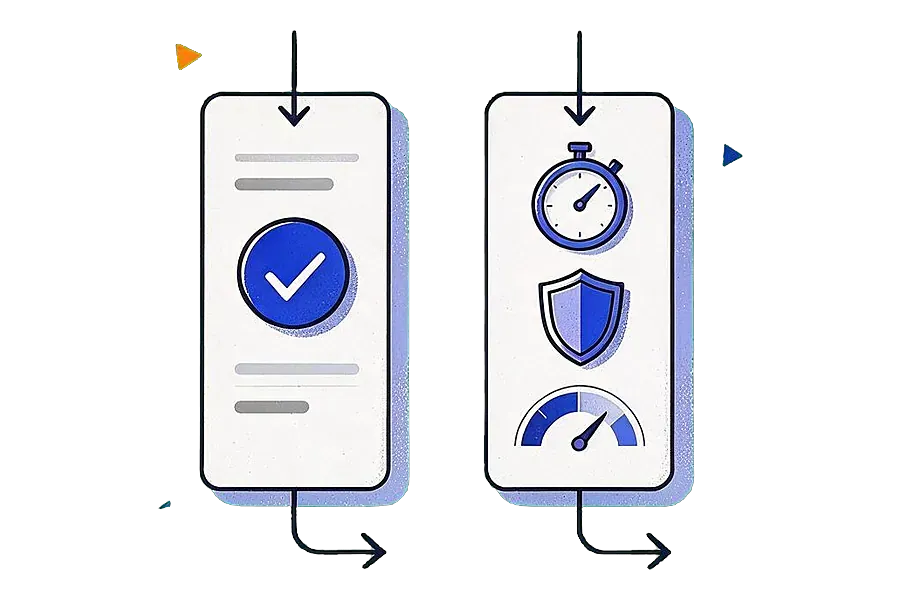
- Speed. Functional: the app shows the transaction list on the home screen. Non-functional: the list loads within 1.5 seconds on a 4G connection.
- Security. Functional: the app signs the holder out after 10 minutes without activity. Non-functional: all traffic uses TLS 1.2 or later.
- Accessibility. Functional: the holder can increase the text size from the settings screen. Non-functional: every screen meets WCAG 2.2 level AA.
- Availability. Functional: the app shows a maintenance message when the service is down. Non-functional: the service is available 99.9% of each calendar month.
When a statement mixes both, split it. "The holder can export transactions quickly" becomes one functional requirement for the export and one non-functional requirement with a number for "quickly".
How do you write a good functional requirement?
Write one behavior per requirement, give it an ID, and attach acceptance criteria that prove it. A short pattern works well:
- Name the actor or trigger. Who or what starts the behavior?
- State the action in the active voice, with "can" for a user capability or "shall" for system behavior.
- State the result someone can observe: a screen, a message, a record, a notification.
- Add limits and rules that belong to it, such as "up to 10 contacts", or reference a business rule by its ID.
- Write acceptance criteria in Given/When/Then form before the work starts.
Avoid words a tester cannot check: "user-friendly", "flexible", "etc." Our acceptance criteria examples show the Given/When/Then patterns that make a functional requirement testable.
Where do functional requirements go?
In a business requirements document, functional requirements usually sit in a numbered list grouped by feature, next to the business rules they enforce. In a product requirements document, they often appear as user stories with acceptance criteria. Either way, each one needs an ID so tests and design can point at it.
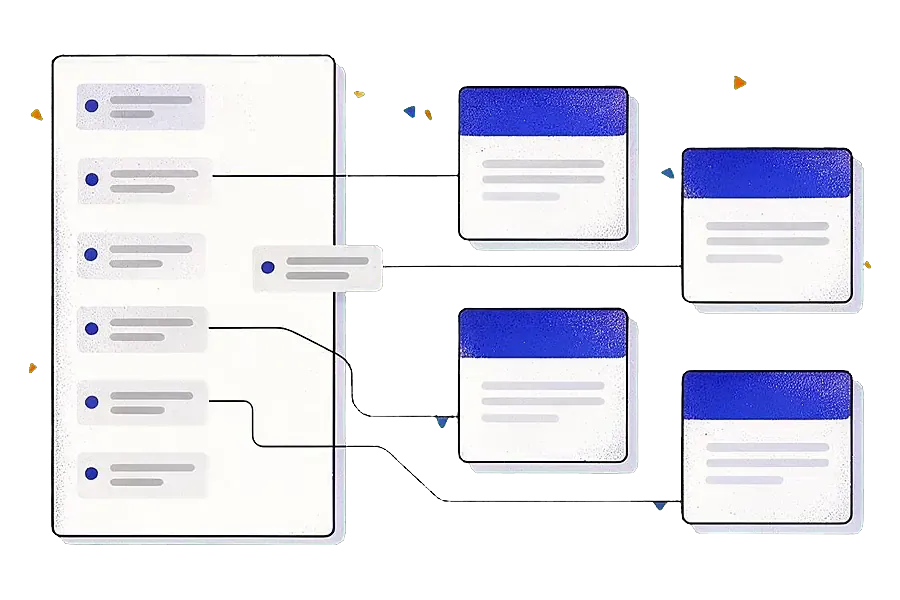
Use cases are the other common home. A use case writes the behavior as a sequence of steps, with alternate and exception flows for the variations and failures. Many functional requirements then map to one or more steps of a use case. A use case template has sections for flows, actors and business rules.
Non-functional requirements rarely map to a single step. Give them their own IDs in a quality section and reference them from the features they constrain, as our non-functional guide describes. The business requirements document template shows where both sections sit.
How does Flowifex handle the two kinds?
Flowifex requirements have four types: Business Requirement, Business Rule, Feature and Requirement. Each one carries a MoSCoW priority, a status and acceptance criteria. There is no separate non-functional type. Teams usually record a quality as a Requirement and make its title say so, for example "Performance: split confirmation within 2 seconds".
Functional requirements link to the individual use case steps that deliver them, so a step with no requirement, or a requirement with no step, shows up in the traceability matrix. Business rules belong to the use case they apply to, each with its own reference ID. See requirements management software for business analysts for how requirements, steps and the generated BRD stay linked.
Before you rank the list, our guide to MoSCoW prioritization covers how to sort functional and non-functional requirements with the same method.
Frequently asked questions
A statement of something the system must do: accept an input, perform an action or calculation, and produce a result. "The app sends the holder a receipt after each transfer" is a functional requirement.
Both kinds exist. "The app locks the account after five failed sign-in attempts" is a functional security requirement, because it describes behavior. "Passwords are stored with a salted, slow hash" is usually treated as non-functional, because it constrains how the system is built.
Neither. A system that does the right thing too slowly fails, and so does a fast system that does the wrong thing. Prioritize each requirement on its own merits with a method such as MoSCoW.
A business rule is a policy the business follows, like a daily transfer limit. The requirement that the system enforces it is functional. Keep the rule as its own statement with an ID, and reference it from the requirements and steps that apply it.
Keep every spec in one place. Start with a free project.
Model use cases, link requirements and generate your BRD. Free plan, no card needed.