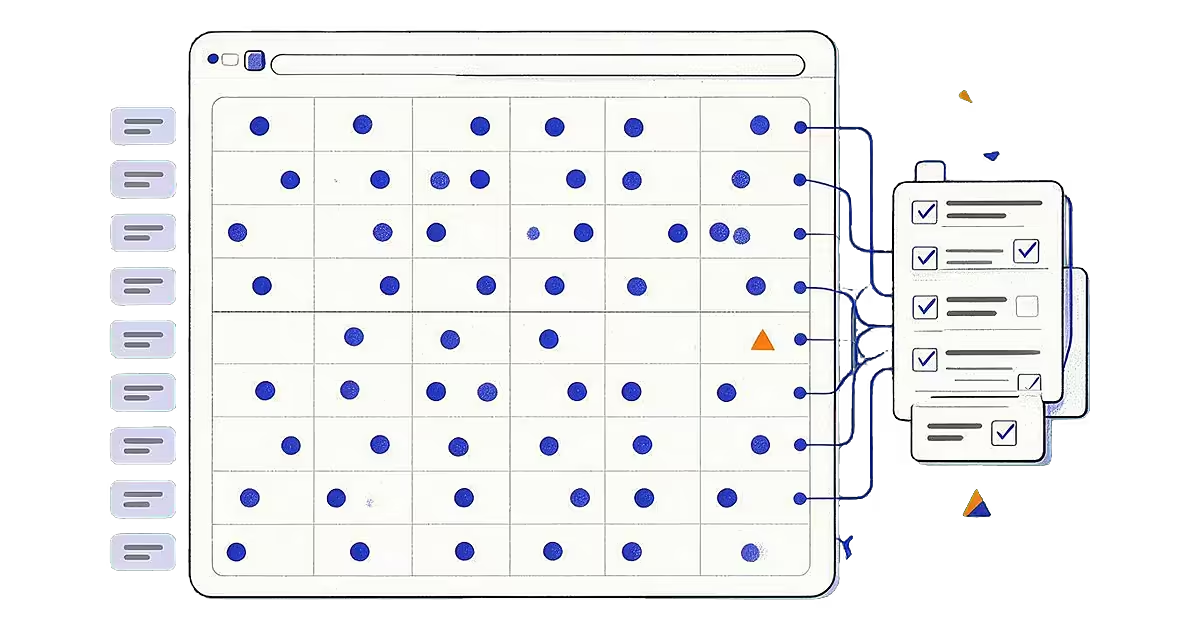
Below is a complete requirements traceability matrix (RTM) example for a fictional bill-splitting feature. It traces eight requirements forward to use case steps, test cases and status, then runs the backward check from tests to requirements. Copy the table, replace the rows with your own, and keep at least one gap visible while you learn to read it.
If you need the definition first, start with what a requirements traceability matrix is. This page is the worked sample: real-looking rows, the gaps they reveal, and two variants for regulated and agile teams.
What does a requirements traceability matrix example look like?
The sample uses the fictional wallet app Qirsh Wallet, which is adding a feature to split a bill with saved contacts. The use case is UC-07 Split a bill. Every ID, name and status below is invented for illustration. The columns work the same in a spreadsheet or in requirements management software.
| Req ID | Requirement | Source | Use case step | Test case | Status |
|---|---|---|---|---|---|
| REQ-01 | The holder can select up to 10 saved contacts for one split. | Product owner | UC-07 step 2 | TC-101, TC-102 | Passed |
| REQ-02 | The app divides the amount evenly and shows each share before sending. | Workshop, 3 March | UC-07 step 4 | TC-103 | Passed |
| REQ-03 | The holder can change any share before sending. | User interviews | UC-07 alt flow 4a | TC-104 | Failed |
| REQ-04 | Each contact receives a request with the amount and a note. | Product owner | UC-07 step 6 | TC-105 | Passed |
| REQ-05 | A declined request notifies the holder with the reason. | Support team lead | UC-07 exception 6b | TC-106 | Not run |
| REQ-06 | A split total cannot exceed the daily transfer limit. | Compliance officer | None | None | Gap |
| REQ-07 | Every split request is written to the audit log. | Compliance officer | UC-07 step 7 | None | Gap |
| REQ-08 | The holder can see the status of each share in one list. | User interviews | UC-12 step 1 | TC-110 | Passed |
How do you read this RTM sample?
Read it one row at a time and ask two questions: does this requirement reach a step, and does a test prove it? Seven of the eight requirements reach a use case step, so step coverage is 7 of 8. Six of the eight have a test, so test coverage is 6 of 8.
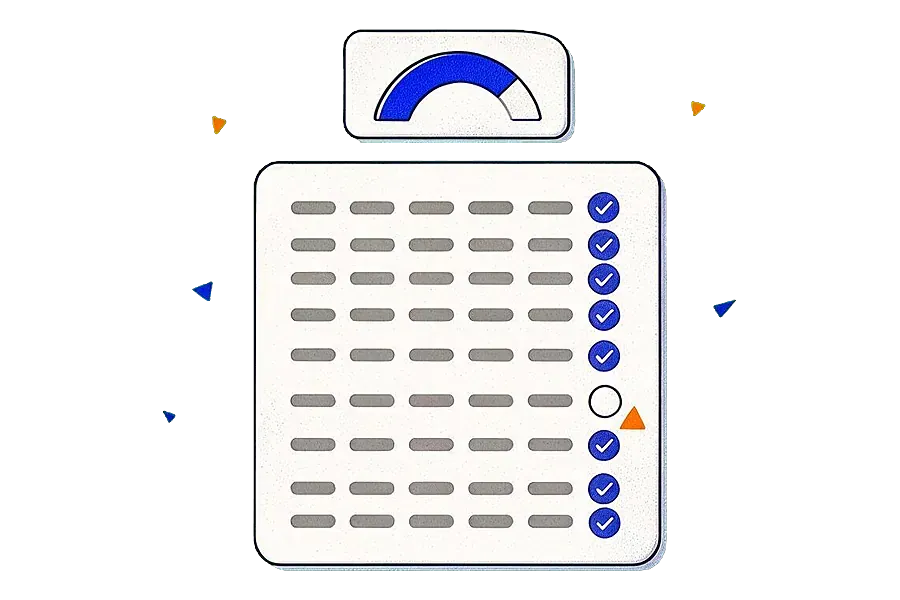
The two gap rows are the reason the matrix exists:
- REQ-06 has no step and no test. The daily limit rule came from compliance, but nobody wrote where the app checks it. Add a validation step to UC-07 and a test that tries to exceed the limit.
- REQ-07 has a step but no test. The audit log is designed but unverified. Add a test that reads the log after a split.
The status column tells a different story from the links. REQ-03 is fully traced and still failing, so the trace is fine and the build is not. REQ-05 is traced but its test has not run, which is a planning item, not a design gap.
What does backward traceability look like in the example?
Forward traceability starts from requirements. Backward traceability starts from the work and asks which requirement justifies it. Run it on the test cases, and on the steps if you have time.
| Test case | What it checks | Traces back to | Finding |
|---|---|---|---|
| TC-101 | Select 10 contacts | REQ-01 | OK |
| TC-102 | Selecting an 11th contact is blocked | REQ-01 | OK |
| TC-103 | Even split of $90 among 3 contacts | REQ-02 | OK |
| TC-107 | Split by percentage | None | No requirement: scope creep or a missing requirement |
| TC-110 | Status list shows each share | REQ-08 | OK |
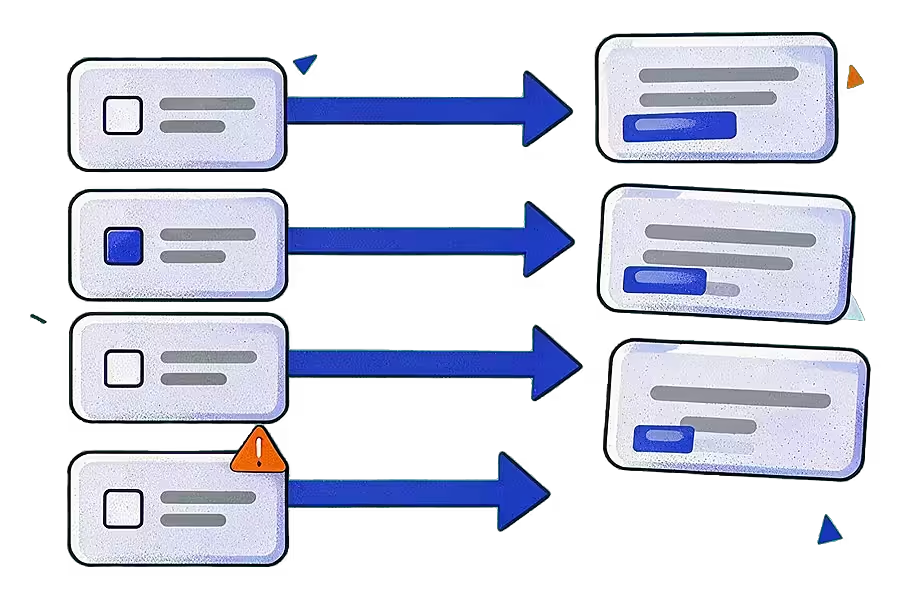
TC-107 is the backward finding. Someone tests a percentage split that no requirement asks for. Either the team built something nobody requested, or a stakeholder asked for it and the requirement was never written. Both answers change the matrix: delete the test, or add the requirement and its step.
What does an RTM example for a regulated project look like?
Regulated and contract work usually adds a verification method to each row. NASA’s requirements verification matrix in the NASA Systems Engineering Handbook is a public example of this layout. The four common methods are inspection, analysis, demonstration and test. ISO/IEC/IEEE 29148, the requirements engineering standard, also expects every requirement to be verifiable, which is what this column records.
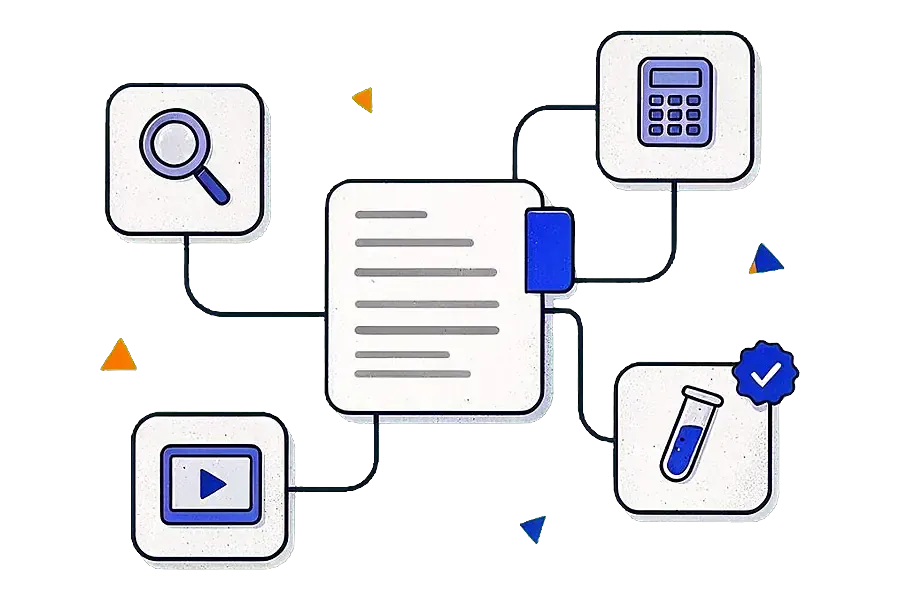
| Req ID | Requirement | Verification method | Evidence | Result |
|---|---|---|---|---|
| REQ-06 | A split total cannot exceed the daily transfer limit. | Test | TC-108 report | Open |
| REQ-07 | Every split request is written to the audit log. | Inspection | Log review record | Open |
| REQ-09 | Split amounts are rounded to the cent, remainder to the holder. | Analysis | Rounding worksheet | Accepted |
| REQ-10 | A support agent can view any split from the admin screen. | Demonstration | Recorded walkthrough | Accepted |
The evidence column is what an auditor reads. It points to a document or a result that someone can open, not to a person’s memory.
What does an RTM example for an agile backlog look like?
Agile teams often trace user stories rather than numbered requirements. The matrix then links each story to its acceptance criteria and to the tests or checks that prove each criterion.
| Story | Acceptance criterion | Test | Sprint | Done |
|---|---|---|---|---|
| US-14 Split a bill | Given 3 contacts and a $90 bill, each share is $30 | TC-103 | Sprint 8 | Yes |
| US-14 Split a bill | Given 11 contacts, the app blocks the request | TC-102 | Sprint 8 | Yes |
| US-15 Decline a request | Given a contact declines, the holder sees the reason | TC-106 | Sprint 9 | No |
Tracing at the criterion level catches a common gap: a story marked done while one of its criteria has no test. Our acceptance criteria examples show how to write criteria that a test can check.
Why do RTM examples in spreadsheets break?
The sample above is easy to read on day one. It breaks when someone inserts a new step 3 into UC-07. Every link that said step 4 or step 6 now points at the wrong step, and the spreadsheet cannot know. Copies emailed for review drift apart in the same way.
Two habits slow the decay. Never reuse an ID, and review the matrix in the same meeting as any change to the use case it points at. The longer answer is to keep links on the step record itself, so a renumbered step keeps its links.
How does this example look in Flowifex?
In Flowifex, each requirement links to individual basic, alternate or exception flow steps of a use case. The links are stored against the step record, not its number, so inserting or moving a step leaves no stale references. The Flowifex traceability matrix shows requirements as rows and use cases with their steps as columns, with total, covered and uncovered counts.
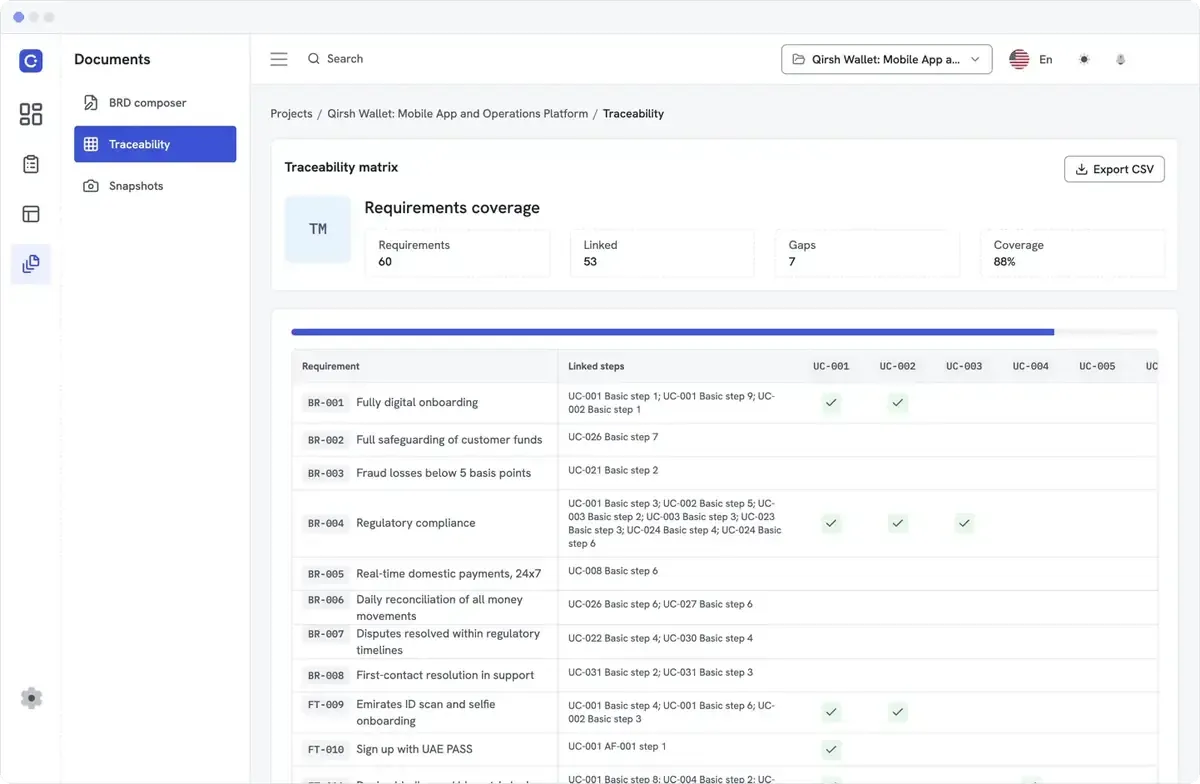
The REQ-06 row from the sample would show as uncovered until someone links it to a step. The matrix exports to CSV for anyone who wants the spreadsheet view. Flowifex has no test case management, so the test case and status columns from the sample stay in your test tool, keyed by the same requirement IDs.
The same requirements and their coverage feed the traceability section of the generated business requirements document. The matrix a stakeholder reads in the BRD is the one the team works from.
Frequently asked questions
At least a requirement ID, the requirement text, its source, the design or use case step that delivers it, the test that verifies it, and a status. Regulated projects add a verification method. Agile teams often add the backlog item or user story ID.
No. A test coverage report starts from the tests. A requirements traceability matrix starts from the requirements and follows each one forward to design and tests, and backward to its source. The test link is one column of the RTM.
Enough to show a gap. A sample with every row fully linked teaches nothing. Eight to fifteen rows, with at least one requirement that has no test and one test with no requirement, show the checks the matrix exists for.
Yes. Each table on this page has plain columns that paste into a spreadsheet. Keep the requirement ID and the step ID as separate columns so you can sort and filter by either one.
Read next
Keep every spec in one place. Start with a free project.
Model use cases, link requirements and generate your BRD. Free plan, no card needed.