A good sample business requirements document, or business requirements document example, has seven parts: an executive summary, a scope statement, stakeholders and actors, a use case catalog, a requirements table with acceptance criteria, a glossary, and a traceability section. Each part answers one question for the reader. This post walks through all of them using a fictional sample project, so you can copy the shape and fill in your own facts.
What does a business requirements document example look like?
A business requirements document (BRD) states what a business needs from a project, in words that sponsors, analysts and delivery teams can all check. The BABOK Guide from IIBA is the standard reference for the business analysis work behind it. It describes the practice. It does not mandate one document layout, so teams settle on a structure of their own.
Flowifex is a use case and requirements modeling tool for business analysts that generates a BRD from a structured project model. The structure below follows the shape of that generated BRD, which has up to 12 sections. The content comes from Qirsh Wallet, an invented mobile wallet for UAE residents. Every name, limit and figure here is sample project data, not a real company.
If you want a blank structure to start from, use the business requirements document template. This post shows the same structure filled in.
What goes in the executive summary?
The executive summary says what the project is, who it serves and what it covers, in one short paragraph. Readers who stop there should still know whether the document concerns them.
Sample project data:
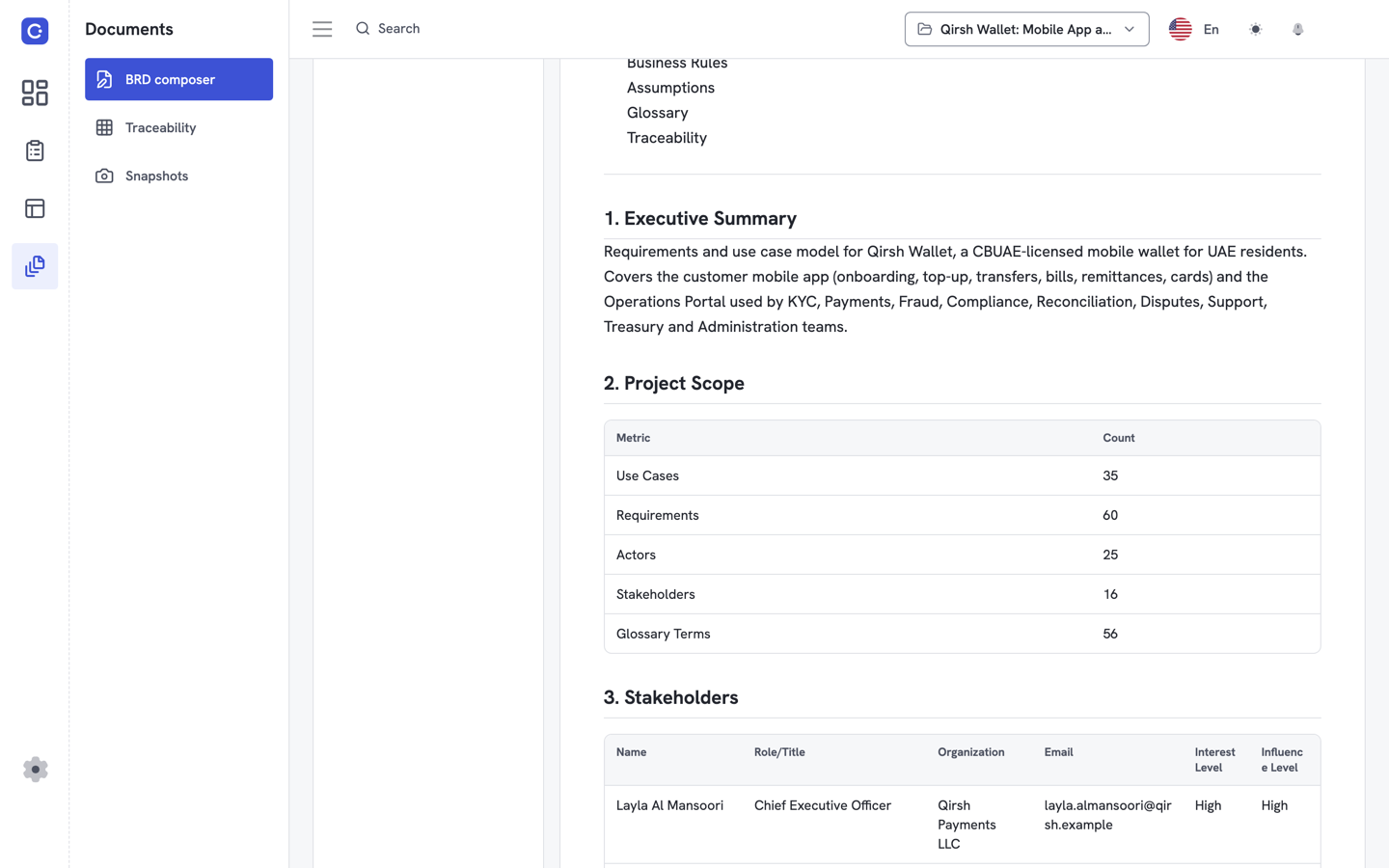
Requirements and use case model for Qirsh Wallet, a licensed mobile wallet for UAE residents. Covers the customer mobile app (onboarding, top-up, transfers, bills, remittances, cards) and the Operations Portal used by KYC, Payments, Fraud, Compliance, Reconciliation, Disputes, Support, Treasury and Administration teams.
Three things make this work. It names the product. It names the two surfaces in scope. It lists the teams affected. It says nothing about how anything will be built.
Keep the summary to three to five sentences. If you need more, the detail belongs in the scope section.
How do you write the scope section?
The scope section sets the boundary of the project in plain terms. State what is in, what is out, and how big the model is.
For Qirsh Wallet, the customer mobile app and the Operations Portal are in scope. A sample exclusion might read: anything that happens inside a partner bank or card scheme is out of scope.
Then add a small count table so a reader can judge size at a glance. A scope section often includes counts like these.
| Metric | What it counts |
|---|---|
| Use cases | Every goal an actor can reach with the system |
| Requirements | Business requirements, features, requirements and business rules |
| Actors | Roles and systems that interact with the product |
| Stakeholders | People with interest in or influence over the project |
| Glossary terms | Defined words the document relies on |
In the Qirsh Wallet sample, the traceability matrix lists 60 requirements with 88% coverage (sample project data).
Write exclusions down on purpose. Unwritten exclusions often lead to late scope arguments.
Who are the stakeholders and actors?
Stakeholders are people. Actors are roles that use the system, and they can include other systems. A BRD lists both because they answer different questions.
Sample project data, stakeholders:
| Role | Interest | Influence |
|---|---|---|
| Chief Executive Officer | High | High |
| Head of Fraud Risk | High | High |
| Head of Payments Operations | High | Medium |
| Head of Internal Audit | Medium | Medium |
The interest and influence columns tell you who must approve, who must be consulted and who only needs updates. Add an actor entry for each role that touches the system, such as customer, KYC analyst or fraud analyst, with a one-line goal for each.
What goes in the use case catalog?
A use case catalog lists each use case by reference number and name, grouped by area. It gives the reader a map of what the product does before any requirement detail.
Sample project data, a fragment of the catalog:
- UC-014 Authorize Payment
- UC-019 Score Transaction in Real Time
- UC-020 Investigate Fraud Alert
- UC-022 Report Unauthorized Transaction
Use verb-and-object names. Group them by department or module. The full detail of each use case, with its main flow, alternate flows and exception flows, sits behind the summary.
For the writing method, see the use case template and the post how to write a use case. To see how the same use cases look as a picture, read the use case diagram tool page.
What should a requirements table include?
A requirements table gives every requirement a reference number, a title, a type, a priority, a status and testable acceptance criteria. A requirement is a statement that translates a need into conditions or capabilities a system must meet (NIST glossary). Without acceptance criteria, a requirement is a wish.
Here is one business requirement from the sample project.
| Field | Value (sample project data) |
|---|---|
| Reference | BR-003 |
| Title | Fraud losses below 5 basis points |
| Type | Business requirement |
| Priority | Must have |
| Status | Approved |
| Source | Head of Fraud Risk |
| Description | Net fraud losses must stay below 0.05% of monthly payment volume without declining more than 1 in 200 genuine payments. |
| Acceptance criteria | 1. Monthly net fraud loss divided by payment volume is below 0.05%. 2. The genuine-payment decline rate attributed to fraud controls is below 0.5%. 3. Both measures are reported monthly to the executive committee. |
Notice that the requirement carries a number, a source and a way to check it. That is what lets a test lead or an auditor close it later.
Flowifex has four requirement types: business requirement (BR), feature (FT), requirement (REQ) and business rule (BRL). Priorities follow MoSCoW labels. For how to assign them, read MoSCoW prioritization for requirements.
How does the traceability section work?
The traceability section shows which use cases cover each requirement, as a coverage matrix, so gaps are visible before development starts.
Sample project data, abridged rows:
| Requirement | Title | Linked use cases |
|---|---|---|
| BR-003 | Fraud losses below 5 basis points | UC-021 |
| REQ-027 | Strong customer authentication for payments | UC-008, UC-009, UC-014 |
| REQ-028 | Real-time fraud scoring | UC-008, UC-019 |
A requirement with no linked use case is a gap to close or to remove.
For a fuller explanation, see what a requirements traceability matrix is and the requirements traceability matrix page.
Why add a glossary and assumptions?
A glossary prevents two people reading the same word two ways. List each term with its definition. In the sample project, terms such as safeguarding account, tier and float need one agreed meaning before anyone writes a rule that uses them.
Assumptions record what the team believes to be true but has not confirmed. Tie each assumption to the flow that depends on it, so a reader can see what a flow relies on. If an assumption turns out false, you know which flows to revisit.
How is the document generated from the model?
In Flowifex you do not type the BRD into a word processor. You build the model: stakeholders, actors, use cases, requirements, glossary and traceability links. Then you generate the document from it.
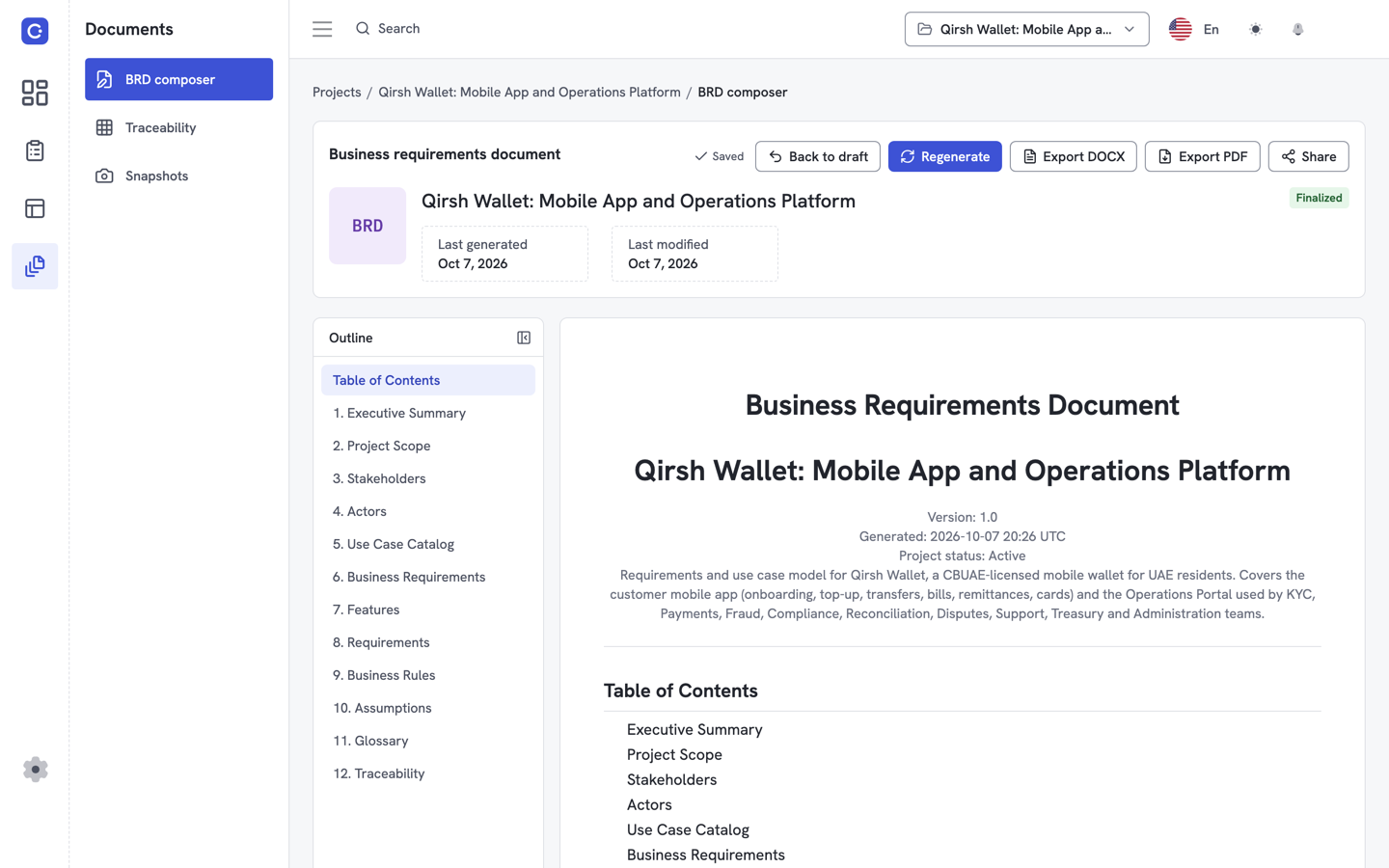
The generated document has up to 12 sections, from the executive summary to traceability and the glossary. It contains text and tables.
Because the document reads from the model, a change to a requirement or a link appears the next time you generate. Nothing is retyped. You can try this on a Free project: Create free account. Plans and limits are on the pricing page.
Sources
- A Guide to the Business Analysis Body of Knowledge (BABOK Guide), IIBA
- Requirement, NIST Computer Security Resource Center glossary
Frequently asked questions
Length follows the project. A small change may need only a short document, while a product with many use cases needs a catalog and tables. Cover the seven parts (executive summary, scope, stakeholders and actors, use case catalog, requirements table, glossary, traceability) and stop when each reader's question is answered.
No. A BRD states business needs and outcomes. A software requirements specification states what the system must do to meet them, in more technical detail. It is usually longer and aimed at engineers and testers. You can keep both and link them.
A BRD executive summary names the product, says who it serves, lists the surfaces and teams in scope, and stays at three to five sentences. It says nothing about how the system will be built. Detail belongs in the scope section.
Read next
Keep every spec in one place. Start with a free project.
Model use cases, link requirements and generate your BRD. Free plan, no card needed.